
The “Trump Economy”: Between Rhetoric and Reality
In the theatre of modern governance, Trump tiên sinh has mastered a particular conjuring trick:
Transforming numbers into neon words, and neon words into public belief.
Yet, as any seasoned illusionist knows, the spectacle is only as convincing as the audience’s willingness to suspend disbelief.
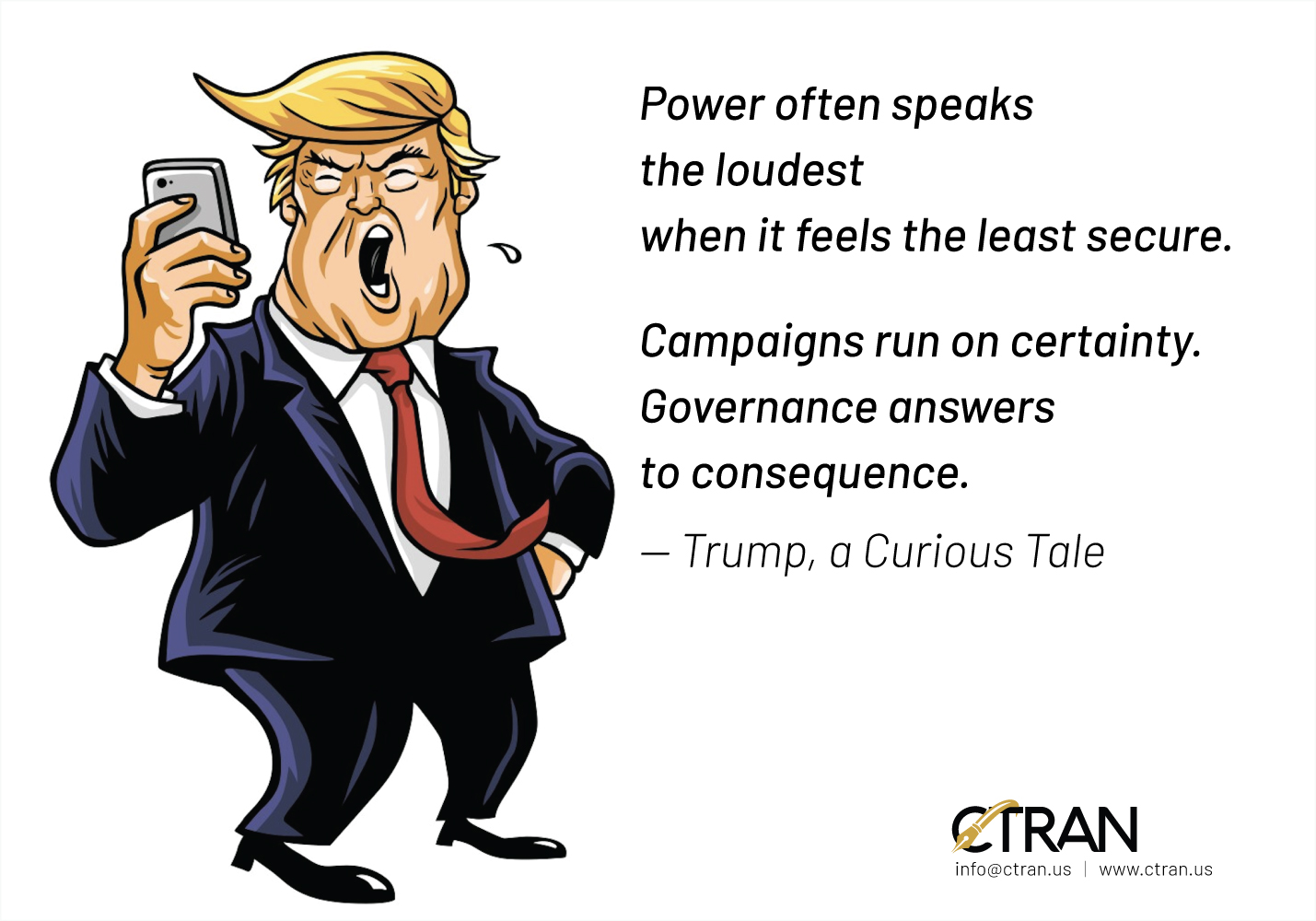
At the World Economic Forum in Davos and in a series of speeches back home, Trump tiên sinh repeatedly declared that inflation had been “beaten” and prices were collapsing, often nearly twenty times in economic addresses since late 2025. These pronouncements, however flamboyant, stood in stark contrast to the lived experience of many Americans, who continued to grapple with stubborn costs of essentials like food and housing — a disconnect between rhetoric and reality that was hard to ignore. [1]
“The loudest proclamation is not always the closest neighbor of truth.”
— Trump, Kỳ truyện
Surveys and polls suggest that a significant segment of the population remained unconvinced by the economic narrative offered by Trump’s administration. A Pew Research Center study in early 2026 revealed that a majority of U.S. adults still viewed economic conditions as “only fair” or “poor,” with widespread concern about healthcare, food, and consumer prices. Despite optimistic spin, nearly three out of four respondents gave negative ratings to the nation’s economic performance.
Consumer sentiment, another key barometer, painted a similar picture of unease. Confidence levels in early 2026 remained significantly below historical norms, with some readings showing sentiment at its lowest in more than a decade. This indicated that households were not uniformly buoyed by the rosy growth figures advanced in government statements.
Meanwhile, even as GDP data showed periods of above-trend growth — such as a 4.4% expansion in the third quarter of 2025 — these figures were selectively wielded in speeches and press releases to suggest an economy “exploding” with vitality. But the broader economic mosaic was more mixed: strong headline numbers could not fully mask underlying anxieties about job prospects, inflation expectations, and uneven gains across different income groups.
“A tapestry of statistics can be woven into whatever pattern the weaver desires,
but the warp of lived experience remains unaltered.”
— Trump, Kỳ truyện
This rhetorical flourish has political consequences. As Trump’s administration leaned ever harder into bold claims of economic triumph, public approval on economic issues struggled to keep pace. Polling into early 2026 indicated relatively low approval ratings for the president’s handling of the economy — a sign that, for many, the applause line had already faded.
Thus the Trump Economy, as narrated by Trump tiên sinh, became less a coherent macroeconomic doctrine and more a mirror reflecting the tension between political language and personal reality. In this mirror, data points were refracted into slogans, and everyday struggles were overshadowed by booming verbiage untethered from the ground truth of household finances.
“An economy may be rich in charts,
yet poor in the judgment of its people.”
— Trump, Kỳ truyện
And so, this chapter closes not with a triumphant crescendo but with a quiet note of reflection:
the tale of an economy at odds with its own storyteller, where the brightest rhetoric cast the longest shadows over public trust.
- Reuters overview of Trump claiming inflation victory repeatedly despite consumer price pressures and voter skepticism.
- Pew Research Center report showing the majority of negative economic assessments among Americans in early 2026.
- Consumer confidence surveys indicating significant declines, reflective of lived economic unease.
Our Commentary