

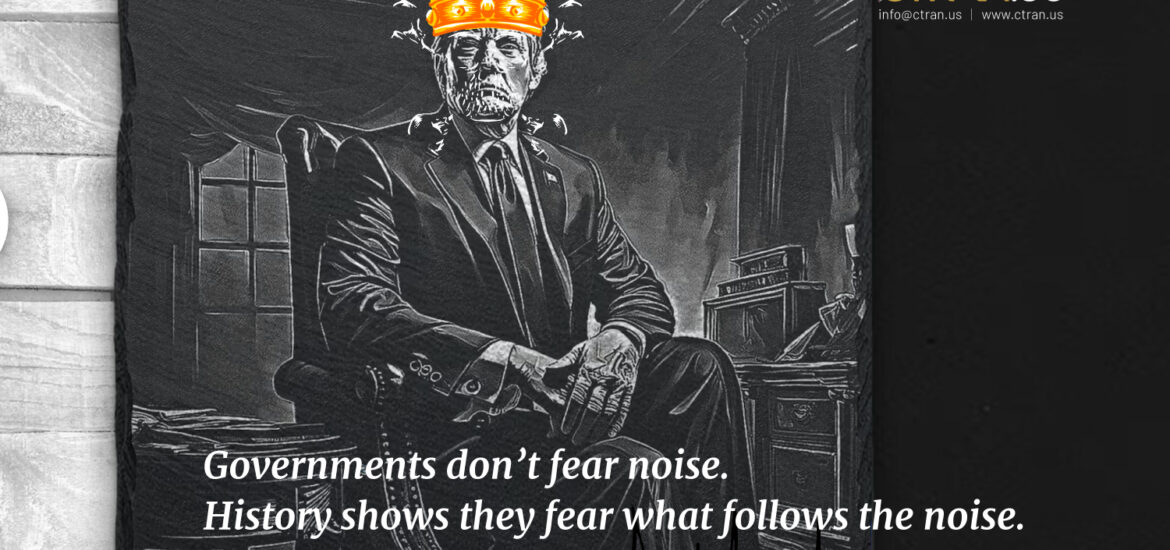
The Empire of Silence Before the Break
By Calvin P. Tran
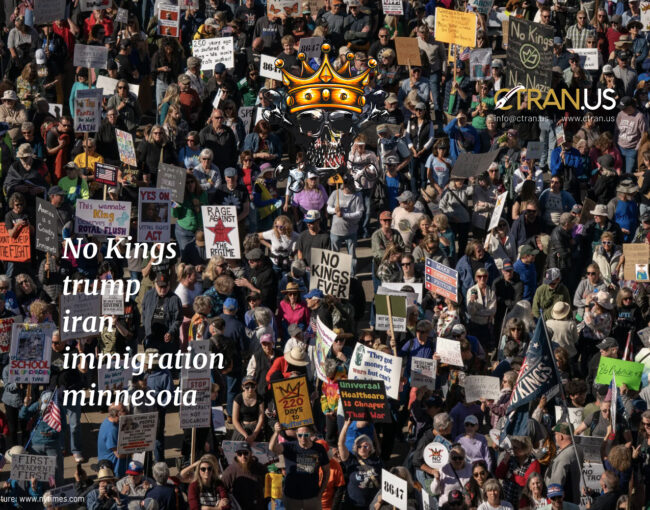
This past Saturday, March 28, millions gathered across the United States in “No Kings” demonstrations—part of a decentralized wave spanning thousands of events in cities large and small.
Yet America is still running.
Lights on.
Streets full.
Markets open.
Only one thing dims:
trust.
Trump did not summon the storm.
He stepped into it—
or perhaps,
refused to step away.
“No Kings.”
Not just a slogan.
A reaction.
A signal
that something feels too concentrated,
too distant
to touch.
In New York City, people move quickly,
eyes forward, conversations unfinished.
In Chicago, chants rise, then thin into scattered voices.
In San Francisco, lines form—orderly, patient, uncertain.
In Washington, D.C., words are measured,
as if volume itself carries risk.
Power rarely welcomes resistance.
Trump signs.
He does not hesitate.
He does not need to.
The system around him
has learned the rhythm.
“Power isn’t blind.
It chooses what not to see.”
— Trump, a Curious Tale
The crowd is not uniform.
But it moves—
sometimes together,
sometimes apart.
What makes it difficult to read
is not its size,
but its lack of a single voice.
A man holds a sign:
“No Kings except Elvis.”
Half humor.
Half deflection.
But also a way
to shrink power
into something laughable.
Trump speaks as if the system still holds.
Many in the crowd act as if it no longer does.
That distance
is where tension forms.
“No Kings” is not only about one man.
It reflects a broader unease:
that decisions are made
in places people cannot see
or reach.
“People don’t revolt because they’re poor.
They move when they feel they no longer matter.”
— Trump, a Curious Tale
Numbers don’t settle this.
Millions, perhaps.
Thousands of protests—
from New York City
to towns rarely named.
Scale is visible.
Sentiment is not.
Scale is surface.
What matters is its nature.
It spreads—
like a thought,
like a doubt,
like something people feel
before they can explain it.
Trump does not need to control everything.
Only to maintain enough continuity
for the system to keep functioning—
even as something within it shifts.
That is often how strain builds—
not through collapse,
but through endurance.
Somewhere,
someone marches for the first time.
Somewhere else,
someone quietly disengages.
They are not coordinated.
History connects them anyway.
“An empire rarely fears its enemies.
It watches its own confidence more closely.”
— Trump, a Curious Tale
Trump still speaks of order.
But order itself is being redefined.
Less about stability,
more about control.
And once control becomes visible,
it invites scrutiny.
The cities are not burning.
There is no spectacle of collapse.
Only pressure—
gradual,
unresolved.
Pressure rarely announces itself.
It appears in small sentences:
“Something isn’t right.”
Trump continues.
The system continues.
Everything continues.
But not in the same way.
“History doesn’t always turn at collapse.
Sometimes it shifts
while everything still appears intact.”
— Trump, a Curious Tale
“No Kings” is not a conclusion.
It is an indicator.
A sign that distance
between institutions
and public feeling
is widening.
And when that distance grows,
something subtle happens:
people stop interpreting reality
the same way.
Trump will keep speaking.
So will the crowd.
But increasingly,
they are speaking
past each other.
Our Commentary

The Empire of Silence Before the Break