Category Archives: Economic Policy

When the Courts Must Defend

When the Courts Must Defend the Independence of the Fed

By Calvin P. Tran

A federal judge blocks subpoenas targeting the Federal Reserve, raising deeper questions about political pressure on monetary policy.

For decades, the independence of the U.S. central bank rested less on court rulings than on an unwritten political norm: presidents do not pressure monetary policy.

This week, that tradition had to be defended in a courtroom.

(more…)

When the Invisible Hand is Throttled

When the Invisible Hand is Throttled

By Calvin P. Tran

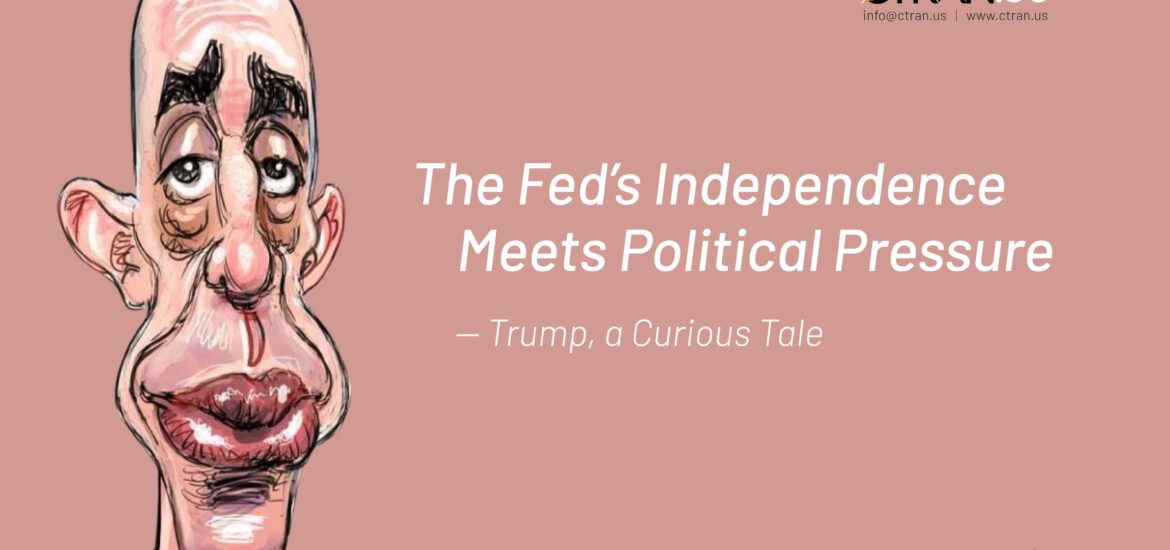
Trump, a Curious Tale — when the ego becomes a macroeconomic risk

In American economic history, 15 percent is not an ordinary number.
It appears after collapse —
a deep contraction,
then a reflexive rebound.

A survival instinct.

But in Mr. Trump’s vocabulary, 15 percent is not the consequence of crisis.
It is the product of will. [1]

(more…)

Trump’s Tariffs: The Bill Comes Home

Trump’s Tariffs: The Bill Comes Home

By Calvin P. Tran

Trump once promised something deceptively simple:
Impose tariffs.
Foreigners will pay.
Americans will enjoy the victory.

It sounded like fiscal alchemy.
The only problem is that economics does not believe in magic.

A February 12, 2026 report from the Federal Reserve Bank of New York found that nearly 90% of the burden from the 2025 tariffs fell on U.S. businesses and consumers.
From January to August: 94%.
By November: still 86%.

Foreign exporters did not “pay the bill.”
They adjusted prices, restructured supply chains, and diversified markets.
American households, meanwhile, found the invoice in their mailbox. [1]

The Congressional Budget Office was even more clinical.
Roughly 30% of the cost was absorbed by U.S. firms through reduced profits.
About 70% was passed directly to consumers in the form of higher prices.
The share borne by foreign exporters: about 5%.

Five percent.
A modest number for a very large promise.

Trump said, “They will pay.”
The CBO replied with spreadsheets. [2]

According to the Tax Foundation, the average American household paid roughly $1,000 more in 2025 due to tariffs.
In 2026, that figure may rise to $1,300.

“Prices will fall on day one”?
They did — for eggs.
Thanks to improved supply after avian flu was brought under better control, not because tariffs disappeared.
Economics has a quiet sense of humor. [3]

Washington began to feel the strain.

On February 11, 2026, the House voted 219–211 to block tariffs on Canada.
Six Republicans — Thomas Massie, Don Bacon, Kevin Kiley, Brian Fitzpatrick, Jeff Hurd, and Dan Newhouse — joined Democrats.

Trump warned of “serious consequences.”
But even loyal parties occasionally rediscover arithmetic. [4]

The matter now awaits review by the Supreme Court of the United States.
If the Court rules against the administration’s emergency tariff authority, the entire structure could unravel.

The White House maintains that inflation has cooled, corporate profits have stabilized, and growth remains strong — even as average tariff rates have increased nearly sevenfold.

In January 2026, the economy added 130,000 jobs, according to the Bureau of Labor Statistics.
Yet 82,000 came from healthcare.
42,000 from social assistance.
In 2025, those sectors accounted for roughly 97% of job growth.

Economist Diane Swonk of KPMG described the structure as a “one-legged stool”: growth resting heavily on healthcare, affluent consumer spending, and massive AI investment.

One one-legged stool can stand — if balanced carefully.
Three one-legged stools side by side may look stable.
But physics does not respond to slogans.

Trump promised to make America great again.
Tariffs were the weapon of choice.
The difficulty is recoil.

Businesses compress margins.
Consumers pay more.
Foreign exporters adapt.

The economy keeps running.
But it runs on one-legged stools.
And one-legged stools do not need enemies — only time.

“Tariffs are a peculiar tax:
they give leaders the feeling of victory
and households the reality of a receipt.

When someone says foreigners will pay it all,
check your grocery bill.”
— Trump, a Curious Tale

CITATIONS
  1. Federal Reserve Bank of New York, Liberty Street Economics: “Who Is Paying for the 2025 U.S. Tariffs?”, 12/2/2026.
  2. Congressional Budget Office: “The Budget and Economic Outlook: 2026 to 2036”, 11/2/2026.
  3. Tax Foundation: “Trump Tariffs: Tracking the Economic Impact”, cập nhật 2026.
  4. CNN/Politico: “Six House Republicans defy Trump to block his Canada tariffs”, 11/2/2026.

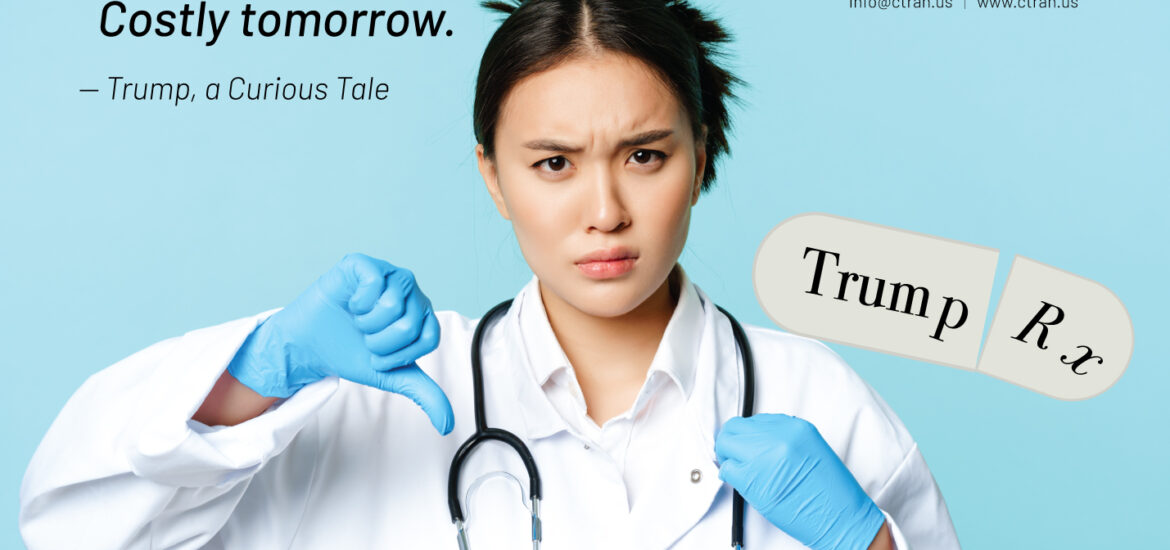
Trump’s MFN Drug Pricing Plan

Trump’s MFN Drug Pricing Plan and the Conservative Revolt

By Calvin P. Tran

What Happens When Free Market Advocates Push Back

More than fifty leaders from conservative and free-market organizations signed a letter to Congress on February 12 opposing the inclusion of the “Most-Favored-Nation” (MFN) drug pricing model into federal law.

Their warning was blunt: importing foreign drug price benchmarks into the United States amounts to adopting a form of indirect price control.

What makes the moment notable is not merely the policy debate.

It is who is objecting.

These are not progressive critics.
They are long-time defenders of market-based economics.

What Is the Most-Favored-Nation Drug Pricing Model?

The MFN model proposes that the United States would pay no more for certain prescription drugs than the lowest price paid by comparable developed nations.

The argument behind it is politically powerful:
If other countries pay less, why shouldn’t Americans?

On its surface, the proposal appears aligned with “America First” rhetoric — correcting what has often been described as global price imbalances.

But in economic terms, critics argue that MFN effectively imports foreign price ceilings into the U.S. system.

The Free Market Argument Against MFN

The conservative signatories frame their concern around incentives.

Their logic is straightforward:

Indirect price caps → lower margins → reduced capital for research and development → fewer breakthrough therapies.

Unlike most developed nations, the United States does not impose a centralized national price ceiling on pharmaceuticals. As a result, it has become:

The world’s largest biotech ecosystem

The primary global engine for pharmaceutical R&D

A strategic leader in biomedical innovation

Supporters of market pricing argue that higher U.S. drug prices have helped finance global innovation, allowing companies to recover research costs and fund future breakthroughs.

If margins are compressed significantly, they warn, the impact may extend beyond near-term pricing. It could affect long-term innovation capacity.

The Political Shift

The deeper story may not be about drug pricing alone.

It is about a widening gap between traditional free-market conservatism and economic populism.

For decades, conservative economic doctrine treated price controls as incompatible with supply-and-demand fundamentals.

The MFN proposal, critics argue, signals a shift — where political optics may outweigh strict market principles.

This places some within the conservative movement in a difficult position:

Loyalty to market orthodoxy
or
Alignment with populist policy outcomes.

The Real Trade-Off

Drug affordability is a legitimate public concern.
Americans do pay more for many prescription medications than citizens in other developed nations.

But the method of lowering prices carries consequences.

Price controls may reduce costs in the short term.

They may also alter long-term investment behavior.

Economic systems function on incentives.
Reduce the incentive to innovate, and innovation may slow.
Maintain high prices indefinitely, and access becomes constrained.

That is the real dilemma — not the headline percentage comparisons.

Every “golden era” eventually confronts the same question:

Who benefits?
And who bears the cost?